Deck Calculator
Build Your Estimate
Set your deck size, pick a material, choose your height off grade. Add railings and stairs if you need them. The number updates as you go. No account needed, no email wall, no follow-up call you didn’t ask for.

Quick deck estimate
Answer a few questions — get a ballpark in seconds.
We Priced It the Same Way We’d Quote It
Most online calculators exist to collect your phone number. The number they show is designed to look attractive, not to be accurate. By the time a contractor shows up, the real price is something else entirely. This tool works differently. It’s pulled from the same rate sheet we use on actual proposals.
Every line item you see reflects a real cost decision. Switch from pressure treated to PVC and the price goes up — not arbitrarily, but because PVC demands closer joist spacing, shorter beam spans, and sealed cut ends. Change the deck size and you may cross a structural threshold that adds a footing. The math is real.
Deck building has a lot of moving parts that homeowners rarely see. Our view is that you make better decisions when you understand what drives the cost, so that’s what this tool is built to show you.
About the Range
The plus-or-minus 15% is not a hedge. It’s an honest acknowledgment that soil conditions, site access, grade, and your municipality’s permit schedule all affect the final number in ways we can’t see from here. On a typical accessible lot the actual cost almost always falls within it. A site visit closes the gap.
Included in Every Square-Foot Rate
Helical Footings
We don’t offer concrete tube forms. We’ve watched them heave. Helical screw piles go past the frost line, bear into stable soil, and don’t move. They’re torque-rated to a known capacity and sign-offable by an engineer. That’s the footing under every deck we build, and it’s in the price you see here.
Joist Protection Throughout
Water sits at every fastener hole and board gap on a deck. Joist tape stops it from getting into the framing. On a PVC deck we tape every joist, not just the beams. It costs money. We include it because leaving it out is how framing fails in year eight.
PVC Deck Framing
PVC boards expand and contract more than wood, which means the structure underneath has to be built tighter:
- 2×10 joists on 12-inch centres throughout
- Short-spanned triple 2×10 beams
- Helicals spaced under 8 feet along the beam
- All cut ends and blocks sealed with high-VOC paint
- Joist protection tape on every framing member
Pressure Treated Framing
PT lumber handles longer spans, so the footing schedule is less intensive than PVC. Structurally sound, just a different set of rules:
- Wider bay spacing along the beam than PVC
- Beams clad with joist protection standard
- ACQ-rated hardware throughout
- Helical footings at all support points
- Code-compliant ledger attachment
What We Build With
We build with a carefully selected range of premium materials, including pressure-treated lumber, composite decking, PVC, cedar, exotic hardwoods such as Ipe and Jatoba, and aluminum. As experienced Fiberon and TimberTech AZEK Pro Users, we understand how each material performs over time and can recommend the best option based on your budget, design goals, maintenance preferences, and Ontario's climate. Our focus is on building beautiful, long-lasting outdoor spaces with materials we trust and know inside and out.
Permit Allowance
Permit fees vary by municipality and project scope, so we include a flat allowance in every estimate and settle the actual figure on the formal proposal. We handle the submission. You don’t have to figure out the building department.
The Short Answer on Railings
Building code in Ontario requires CCMC approval on any railing system installed on a permitted deck. The Canadian Construction Materials Centre certifies products individually, and the list of approved systems is not long. That’s why you won’t find forty railing options in this estimator. We price what we can actually install to code.
If You Want Something Custom
It’s doable. A non-CCMC railing design needs its own structural engineering package, and in Canada that stamp doesn’t carry from one job to the next. Each project gets its own engineer. On a high-end build where the railing is the feature, that’s a reasonable expense. On a standard deck, it usually isn’t. Tell us what you have in mind at the site visit and we’ll give you a straight answer.
Deck Size and Cost Don’t Scale Evenly
A 14×22 deck is not just a bigger 12×20. Depending on the spans involved, that extra area might push you into a heavier beam, an additional footing line, or a different permit category. Two feet can mean a surprisingly different project.
It also works the other way. Fixed costs like mobilization, permit, and post bases don’t change much with size, which means a slightly larger deck sometimes costs less per square foot than a smaller one. Use the slider to find where your budget lands most efficiently before you commit to a footprint.
Things People Ask Us All the Time
PVC costs more than pressure treated. Why?
Two reasons. The board itself is more expensive. And the framing underneath has to be built tighter: 2×10 joists on 12-inch centres, shorter beam spans, more closely spaced helicals, sealed cut ends, joist tape on everything. That’s a denser, more material-intensive build than pressure treated.
What you get for it is a deck that doesn’t rot, doesn’t splinter, and never needs staining. Over ten years, most people come out ahead on the PVC side once you add up what a wood deck actually costs to maintain.
Why not just use concrete tube forms?
Tube forms depend on bearing weight against undisturbed soil. Ontario winters push frost deep enough to get underneath them, and when that happens, the footing lifts. We’ve seen it enough times that we stopped offering them.
Helicals screw past the frost line and lock into stable soil mechanically. They’re rated to a specific load, they’re inspectable, and they don’t move. The cost is built into our square-foot rate so it’s not a line item you have to decide on.
My neighbour built without a permit. Do I actually need one?
Probably. Any deck attached to the house needs one in virtually every Ontario municipality. Freestanding decks above a certain height do too, and the threshold varies by jurisdiction. An unpermitted deck creates problems when you sell — lawyers catch it in title searches and it becomes your problem to resolve.
We handle the submission as part of our process. A permit allowance is in every estimate and adjusted on the formal proposal once we confirm your municipality’s fee schedule.
What about composite? I see it everywhere.
Yes, we regularly build composite decks using high-quality products from trusted manufacturers like Fiberon and TimberTech AZEK. Composite decking is a popular choice because it's durable, low maintenance, and available in a wide range of colors and finishes. During your consultation, we'll explain the differences between composite lines, discuss warranty options, and help you determine whether composite, PVC, hardwood, or pressure-treated lumber is the best fit for your budget, lifestyle, and long-term goals.
The range is plus or minus 15%. That’s pretty wide. Why?
Because two decks that are identical on paper can be very different projects in the field. Steep grade means more work under the deck. Rock means drilling, not screwing. A tight side yard means hand-carrying material instead of driving it in. A municipality with a high permit fee moves the number on its own.
On a flat accessible lot with normal soil, most projects come in tight to the midpoint of that range. The 15% exists for the sites that aren’t that. A site visit closes it to a fixed number.
I have a number. What’s the next step?
Contact us to set up a site visit. We come out, look at the lot, talk through what you want to build, and tell you what we see — access, grade, anything that would affect the price. From there, straightforward replacements can move quickly to a formal proposal.
For new builds or anything with design choices still open, we work through a design retainer: floor plan layouts first, then 3D renderings once the layout is right, then permit drawings. We don’t write formal proposals against unfinished designs. The number has to be tied to something specific.
Deck Prices Across Mississauga, the GTA, and Surrounding Areas
Mississauga Decks & Trim builds custom decks and outdoor structures throughout Mississauga, Toronto, Oakville, Brampton, Milton, Burlington, Vaughan, Caledon, Waterdown, Richmond Hill, and surrounding GTA communities. The prices in this estimator are what we actually charge — no bait-and-switch, no surprise quotes.
Deck Cost in Mississauga
Deck cost in Mississauga is our home market. We build throughout the city and are familiar with local permit requirements, neighbourhood regulations, and property layouts.
Deck Cost in Toronto
Deck cost in Toronto varies based on lot access, deck size, and project complexity. We regularly work throughout the GTA and can help navigate permit requirements where applicable.
Deck Cost in Oakville
Deck cost in Oakville reflects the high-quality materials and craftsmanship homeowners expect. We serve neighbourhoods across Oakville with custom deck and outdoor living solutions.
Deck Cost in Brampton
Deck cost in Brampton depends on factors such as deck size, elevation, railings, and material selection. Use the estimator above for a realistic starting point.
Deck Cost in Milton
Deck cost in Milton is influenced by lot conditions, project scope, and design features. We regularly complete projects throughout Milton and surrounding communities.
Deck Cost in Burlington
Deck cost in Burlington follows the same transparent pricing approach shown in this estimator. Site access and elevation changes may affect the final proposal.
Deck Cost in Vaughan and Richmond Hill
Deck cost in Vaughan and Richmond Hill can vary based on permit requirements, custom features, and property conditions. We provide detailed proposals after a site assessment.
Deck Cost in Caledon and Waterdown
Deck cost in Caledon and Waterdown may be affected by terrain, grading, and site accessibility. Helical footings help provide a stable foundation across varying soil conditions.
Come See the Lot With Us
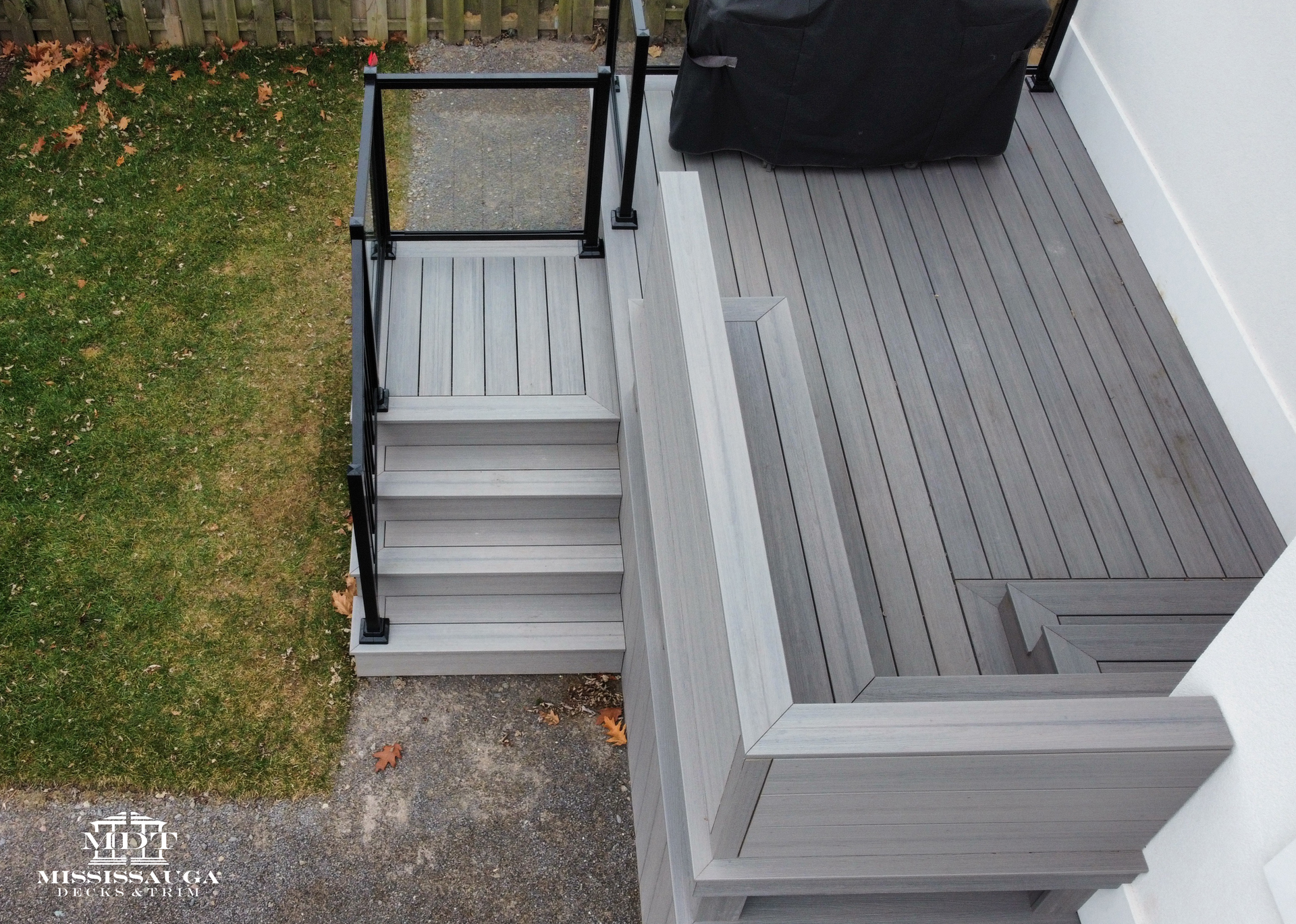
Ready to upgrade your backyard with a custom deck or outdoor living space? Use our deck calculator to explore different sizes, materials, and upgrade options in just a few clicks. From pressure-treated and composite decking to premium railings, covered structures, lighting, and waterproofing systems, you can get a ballpark estimate tailored to your vision.
You’ve got a number — now let’s see the space. Book a site visit and we’ll walk the property with you, discuss the design, and explain what the project will actually involve.